San Ramon · Gale Ranch / Dougherty Valley 94582
Gale Ranch Sub-Zero warming up on hot afternoons? Start at the condenser coil
In Gale Ranch, a Sub-Zero that holds fine all winter but creeps warm on a 100°F Dougherty Valley afternoon is almost always telling you the condenser is starved for airflow — not that the sealed system is dying. The difference is worth hundreds of dollars, and it's visible.
Direct answer
On a hot Gale Ranch afternoon a Sub-Zero that drifts warm usually has a dust-clogged condenser, not a failed compressor. The coil can't shed heat, so the box loses ground exactly when outdoor and kitchen temperatures peak. A cleaning often restores it; we confirm with temps and run-time before quoting. Call (925) 940-3576.
The mechanism
Why heat exposes a dirty condenser before anything else
A Sub-Zero condenser is a heat exchanger: the compressor pumps hot refrigerant through its coil, and a fan pulls kitchen air across the fins to carry that heat away. When the fins are caked with dust, the coil can't dump heat fast enough — so the refrigerant returns warmer than it should, and the whole box loses cooling capacity.
On a mild day there's enough margin that you never notice. But on a Gale Ranch afternoon in July, when Dougherty Valley sits at 95–105°F and the kitchen itself is warm, the condenser is already working at its limit. The dirty coil is the last straw. That's the classic pattern we hear: "it's fine in the morning and warm by dinner" — the unit simply can't keep up once the heat load peaks.
This is also why the freezer often still reads correct while the fresh-food side drifts up. A weakened sealed system protects the coldest zone longest, so the 0°F freezer holds while the 38°F refrigerator slips to the mid-40s. People read that as "the freezer works, so the compressor is fine" — but it's exactly what a heat-starved, dust-packed condenser looks like.
There's a feedback loop hiding in here, too. When the coil can't shed heat, the compressor never satisfies the thermostat, so it keeps running. A compressor that runs longer puts more heat into a coil that already can't keep up — and the fan pulls more dust through the grille the whole time it runs. That's why a Gale Ranch unit can look fine for two summers and then seem to fail "all at once": the margin erodes quietly until one heat wave pushes it over.
Don't replace what you can clean
How a clogged coil mimics a far bigger failure
A dust-packed condenser produces the same headline symptom as a failing compressor or a low refrigerant charge: the box runs warm and the compressor seems to run forever. The cost of being wrong about which one it is can be ten-fold. We diagnose evidence-first so a $200-range cleaning never gets sold as a $900–$1,800 sealed-system job.
Here's how the look-alikes actually differ once you measure them:
| What it is | How it behaves | What we measure | What it actually needs |
|---|---|---|---|
| Dirty condenser (heat load) | Box drifts warm on hot afternoons, recovers on cool nights | Long run-time, hot coil, visible dust mat | Clean condenser; recheck temps over 24h |
| Failing compressor | Both fridge and freezer warm, often constant | High amp draw, won't pump down, abnormal noise | Sealed-system repair, gauges + EPA 608 |
| Low / leaking charge | Slow warm-up, frost only on part of evaporator | Sub-cooling off, oily residue at a joint | Leak find, repair, recharge under warranty if it applies |
| Condenser fan failure | Sudden warming regardless of weather | Fan not spinning, coil hot to the touch | Fan motor replacement |
Why dust loads up so fast
Gale Ranch dust, Diablo wind, and the 3–6 month coil
Sub-Zero's own guidance is to clean the condenser every 6–12 months. In Gale Ranch we shorten that to every 3–6 months, and the reasons are local:
- Hillside construction dust. Dougherty Valley and Gale Ranch are graded hillside tracts; fine soil and grading dust drift indoors and settle on intake grilles faster than on the flats.
- Offshore Diablo winds. Northeast fire-weather winds off the Diablo Range push dust — and in late summer, wildfire-season ash from SCU-type fires — straight onto condenser intakes within days, not months.
- Heat that never lets the coil rest. A coil running near capacity all afternoon pulls more air across itself, so it collects debris faster precisely when it can least afford to.
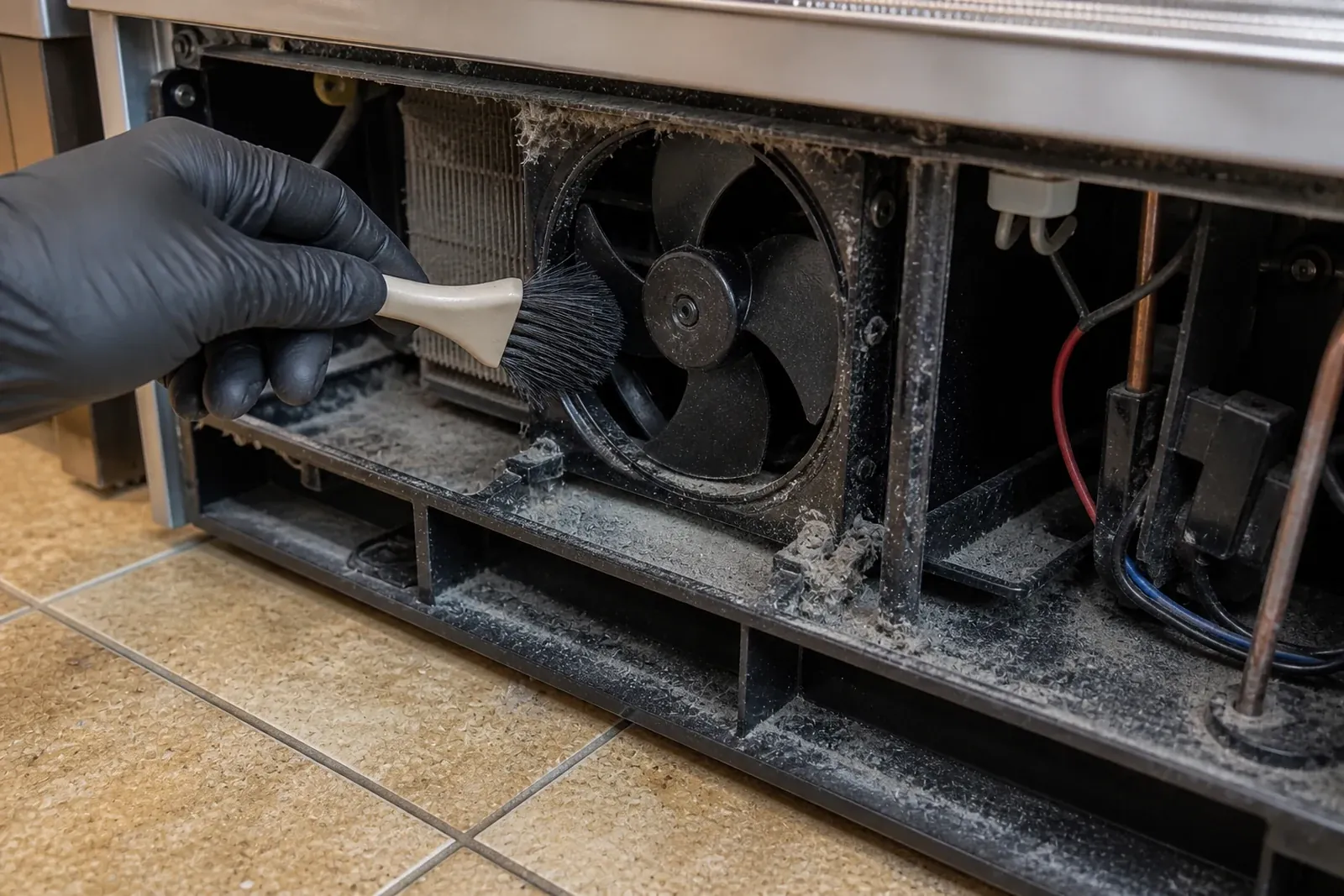
Pets, cooking grease, and a grille right at toe-kick height finish the job. The result is a felt-like mat across the fins that you can lift off in one piece — and that single mat is often the whole problem. A standing reminder lives on our maintenance calendar, and the same dust-and-heat story drives the neighboring Dougherty Valley dust & heat page.
It isn't only the indoor unit, either. Many newer Gale Ranch floor plans came with built-in island or outdoor refrigeration on the patio, and those coils bake in direct afternoon sun while the same Diablo wind drifts ash onto them. A patio fridge in 100°F-plus air has almost no thermal margin to begin with, so its condenser needs cleaning even more often than the kitchen built-in — we treat those as their own service line under outdoor refrigerator repair.
We know the install
Builder-uniform Gale Ranch kitchens make the visit faster
Gale Ranch homes went up in coordinated phases, so the kitchens repeat. We see the same panel-ready built-ins — commonly BI-36 and BI-42 Classic units, plus integrated columns and wine storage in the larger floor plans — set into the same island and end-of-run cabinet positions. That uniformity is an advantage: we usually know where the grille, the model tag, and the airflow path are before we walk in.
On a Classic built-in the condenser sits behind the lower grille and the model/serial tag is inside the door near the top hinge (or, on integrated columns, in the cabinet to the left of the upper drawer). If you snap that tag before we arrive — see the model-number photo checklist — we bring the right grille clip and filter on the first trip.
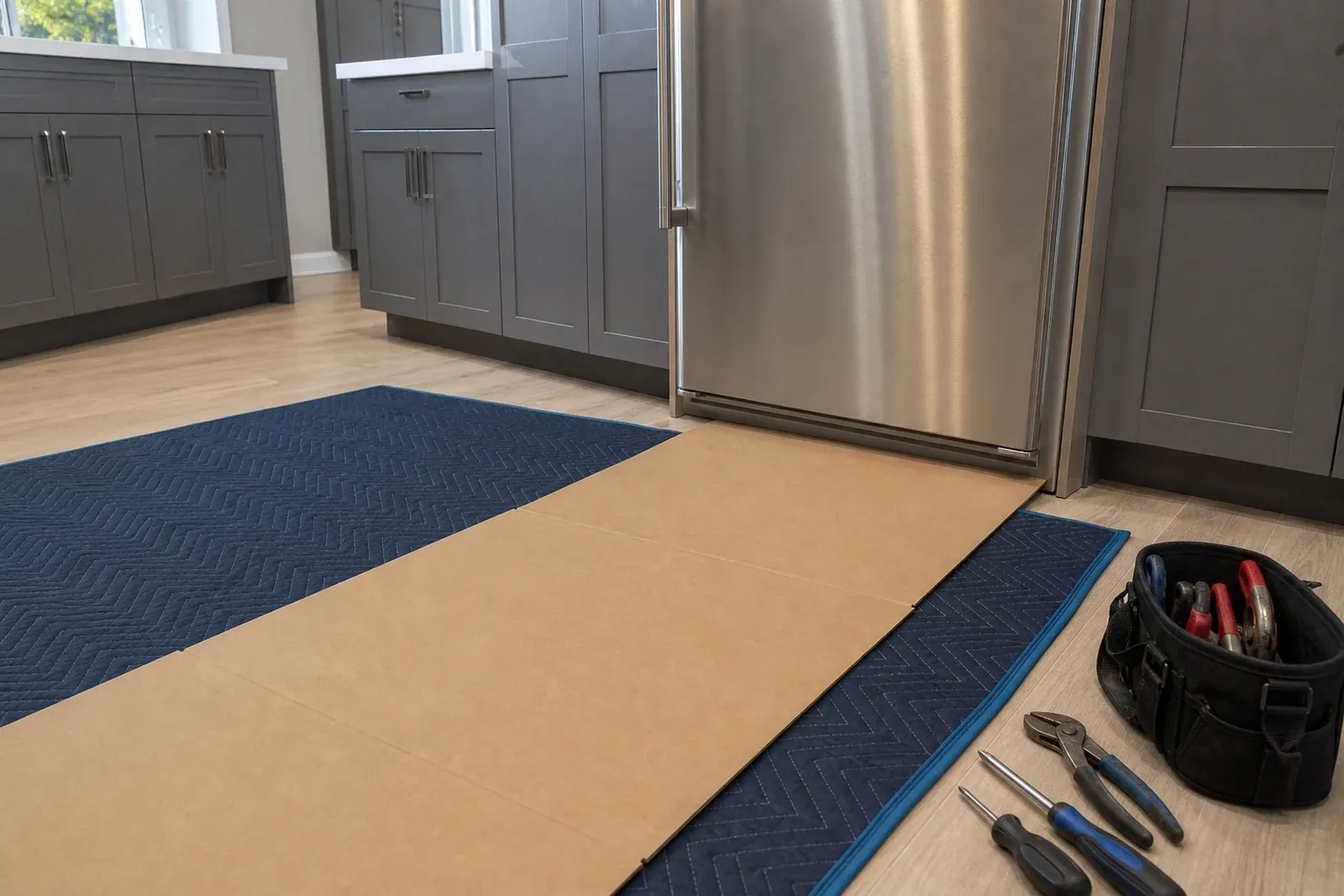
The one install detail that matters most for heat load is clearance: Sub-Zero built-ins exhaust upward, so a unit boxed in tight, with a blocked top vent or a grille pushed against an island return, runs hot even with a clean coil. We check that the cabinet can actually breathe. When a pull-out is needed, we protect the floor and millwork — that's the whole point of cabinet-safe service.
Airflow first
Clearance: the heat-load failure a clean coil won't fix
A condenser can be spotless and the box can still run warm if the cabinet can't move air. Sub-Zero built-ins draw cool air in at the toe-kick grille and exhaust the heat upward, so the install has to give that hot air somewhere to go. In tightly fitted Gale Ranch cabinetry — especially end-of-run and island positions — a few things quietly choke that path:
- A blocked or undersized top vent. If a remodel, a custom panel, or a deep crown closed off the upper exhaust gap, the unit re-breathes its own heat all afternoon.
- A grille pushed flush against an island return or a kick panel so it can't actually pull air in.
- Stored items packed against the back or top of an integrated column, blocking the chimney effect the design relies on.
- Adjacent heat — a wall oven, a range, or a south-facing window dumping extra load right beside the cabinet.
We verify clearance as part of every heat-load call, because cleaning a coil that's strangled by its cabinet just means the customer calls back in three weeks. Two things you can check before we arrive: make sure the lower grille is clear and nothing is shoved against it, and feel the cabinet above the unit — if it's noticeably warm, the exhaust isn't escaping. The mechanism is the same one we walk through for summer-heat warming.
The proof, not the promise
Before/after: what the evidence actually looks like
We don't ask you to take "it was dirty" on faith. On a heat-load call we record the fresh-food and freezer temperatures and the compressor run-time at arrival, show you the coil before and after, then verify the unit holds over the following day before we call it solved. A typical Gale Ranch result:
- Fresh-food temperature falls from the mid-40s back toward the high 30s within 24 hours.
- Run-time drops from near-constant to normal short cycles once the coil can shed heat.
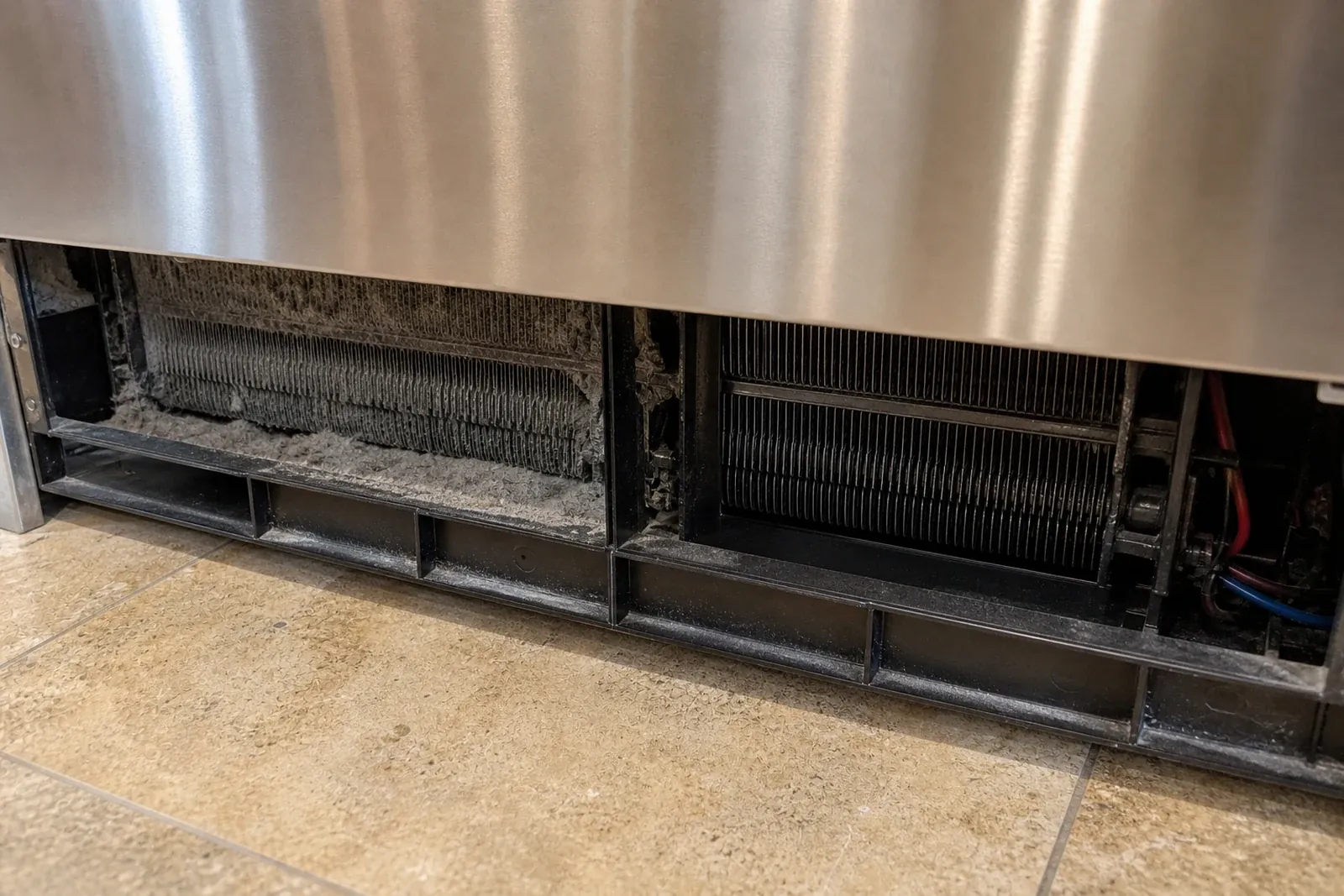
- The coil goes from a packed grey mat to clean aluminum fins — the photo pair at the top of this page is exactly that.
If the numbers don't recover after a clean coil, that's diagnostically valuable too: it points us toward the evaporator fan, defrost, or sealed system, and we walk that path next. The full sequence lives on the not-cooling diagnostic, and if a sealed-system issue is confirmed we handle it under sealed-system & compressor with EPA 608 certification. Diagnostic visits run $95–$150, credited toward the repair.
You can give us a head start. If your Gale Ranch unit is drifting warm, jot down a couple of temperature readings at different times of day before we come — morning and late afternoon — and note whether it recovers overnight. That single observation, that it's worse when it's hottest outside and better by morning, is the fingerprint of a heat-load problem and lets us arrive with the right grille, filter, and a plan instead of a guess. Older 600-series boxes that flash "Vacuum Condenser" or "Service" are the same story in code form: the board is telling you the compressor ran long because the coil couldn't keep up. We clean the condenser first, then clear the alarm with the door-ajar key only once temperatures are back to normal — never while they're still rising.
Next step
Call with the Sub-Zero model number
Have the model-tag photo, current fresh-food and freezer temperatures, and the symptom timeline ready. That lets the San Ramon intake route the visit around the likely Sub-Zero part family instead of a generic appliance script.
FAQ
Questions San Ramon homeowners ask before scheduling
Why is my Gale Ranch Sub-Zero warm but the freezer is fine?
A weakened, heat-starved sealed system protects the coldest zone longest, so on a hot Dougherty Valley afternoon the 0°F freezer holds while the fresh-food side drifts to the mid-40s. The most common cause here is a dust-packed condenser that can't shed heat. Don't assume the compressor is fine — call (925) 940-3576 and we'll measure it.
Does a dirty condenser cause a Sub-Zero to warm up?
Yes. The condenser sheds the heat the compressor pumps out, and a coil caked with Gale Ranch hillside dust and Diablo-wind ash can't do that. Cooling capacity drops, the unit runs long, and the box loses ground on a 100°F afternoon. Cleaning the coil restores most units; we confirm with temperatures over 24 hours before calling it fixed.
How do I know if my Sub-Zero condenser is clogged?
Pull the lower grille and look at the coil: clean Sub-Zero fins are bare aluminum, while a clogged one wears a grey felt-like mat you can lift off in a sheet. Other tells are a near-constant compressor, a hot coil, and warming that worsens on hot afternoons and recovers on cool nights. In Gale Ranch that mat builds in 3–6 months.
Do you service Gale Ranch?
Yes — Gale Ranch and the rest of Dougherty Valley (94582) are core territory for San Ramon Sub-Zero Repair, along with Windemere, Bishop Ranch, Twin Creeks, and the wider Tri-Valley. We know the builder-uniform kitchens and panel-ready built-ins here. Book online or call (925) 940-3576; see all service areas.
How often should a Gale Ranch Sub-Zero condenser be cleaned?
Sub-Zero recommends every 6–12 months, but in Gale Ranch we advise every 3–6. Hillside grading dust, offshore Diablo winds, and late-summer wildfire ash load the coil far faster than the manufacturer's flat-region assumption. A coil cleaned on a regular cadence rarely becomes a heat-load failure on the hottest days. See our maintenance calendar to schedule it.
Will cleaning the condenser fix it, or do I need a compressor?
Most heat-load warming in Gale Ranch resolves with a coil cleaning plus a clear airflow path — far cheaper than the $900–$1,800 sealed-system range. We diagnose evidence-first: temperatures, run-time, and amp draw tell us whether it's the coil or the compressor before any quote. If the numbers don't recover after a clean coil, we walk the next diagnostic step.
Related