San Ramon · Sealed System & Compressor
Both Sides Warm, Long Runs & Loud Humming: Sub-Zero Sealed-System and Compressor Repair in San Ramon
When both the fresh-food and freezer sides of a Sub-Zero drift warm while the unit runs almost nonstop — often with a new humming, buzzing, or droning from the lower compartment — the problem is usually in the sealed refrigeration system, not a simple part. This page explains how we confirm it the right way, what it costs, and why no honest tech quotes a compressor over the phone.
Direct answer
Both compartments warm plus near-constant running and a loud hum usually points to the sealed system — compressor, refrigerant charge, or a restriction. It can only be confirmed on-site with gauges and a compressor amp-draw reading, never a phone quote. The 12-year Sub-Zero sealed-system warranty may still cover the part. Call (925) 940-3576.
Read the symptom
Why both sides warm and constant running point at the sealed system
A Sub-Zero with a single dirty condenser or a failed evaporator fan usually leaves one compartment behaving normally. When both the refrigerator and freezer climb together, and the compressor never seems to cycle off, the cooling itself is weak — the sealed system is moving little or no heat. The most common causes we find on San Ramon calls are:
- Low or lost refrigerant charge from a slow leak in the evaporator, condenser, or tubing — the compressor runs and runs but can't pull temperatures down.
- A restriction (partial blockage in the drier or capillary) that starves the evaporator.
- A weakening or failing compressor — it still hums and draws current but no longer compresses efficiently.
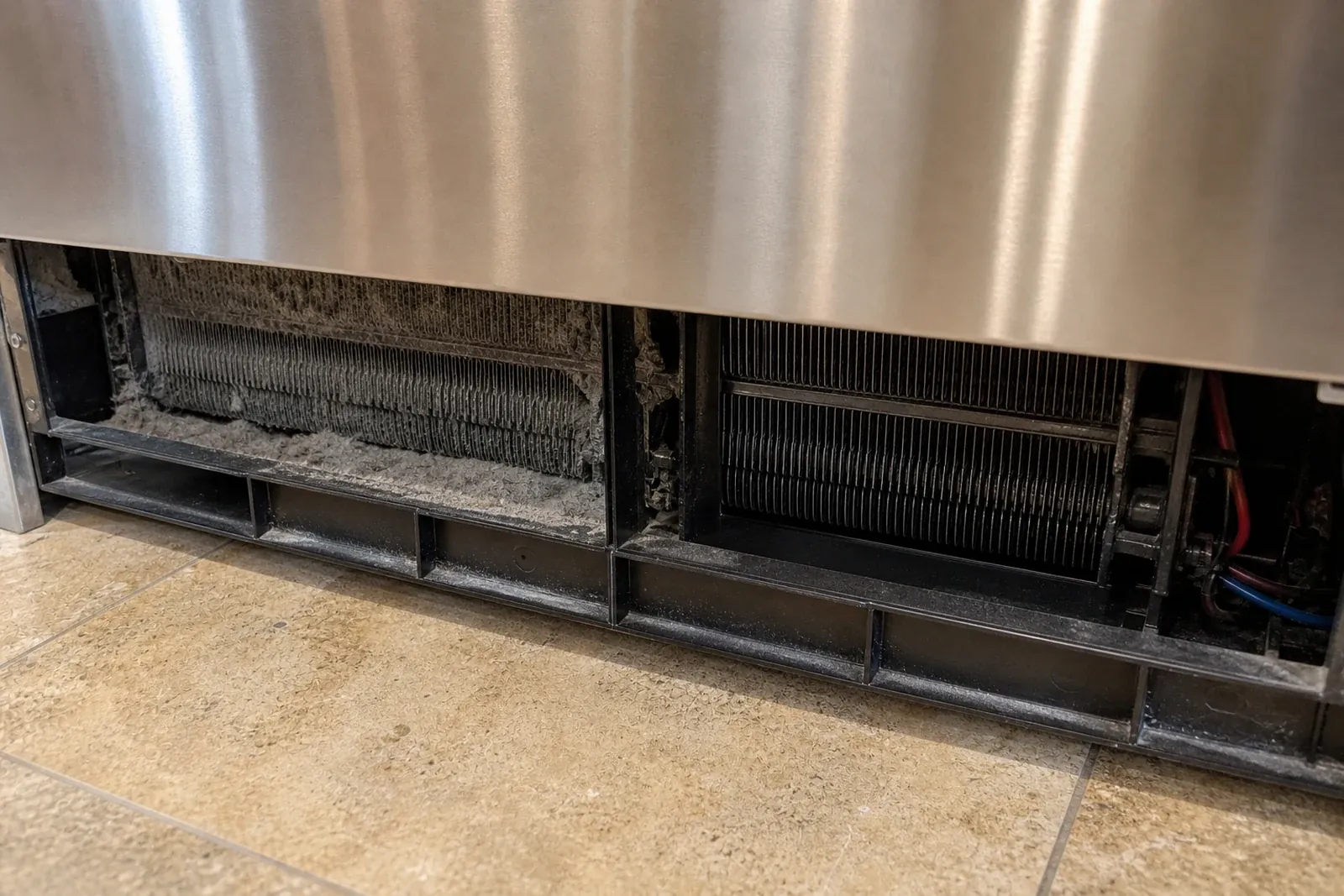
Before any of that, we rule out the cheap stuff: a condenser caked with Diablo-wind dust or wildfire-season ash, a stuck control board, or a defrost fault that mimics warm-everywhere. That is why this starts as a not-cooling diagnostic, not a parts-cannon. In San Ramon's summer heat a filthy condenser alone can drive long runs and warm boxes — and it's a fraction of sealed-system cost.
The honest test
Gauges plus amp draw — why we never quote a compressor by phone
You cannot diagnose a sealed system by description. Two units with identical symptoms — warm, loud, always running — can need a $95 condenser cleaning or a $1,600 compressor. The only way to tell them apart is to put instruments on the machine:
- Refrigeration gauges on the high and low side to read suction and head pressure — a low, flat charge reads very differently from a healthy one or a restriction.
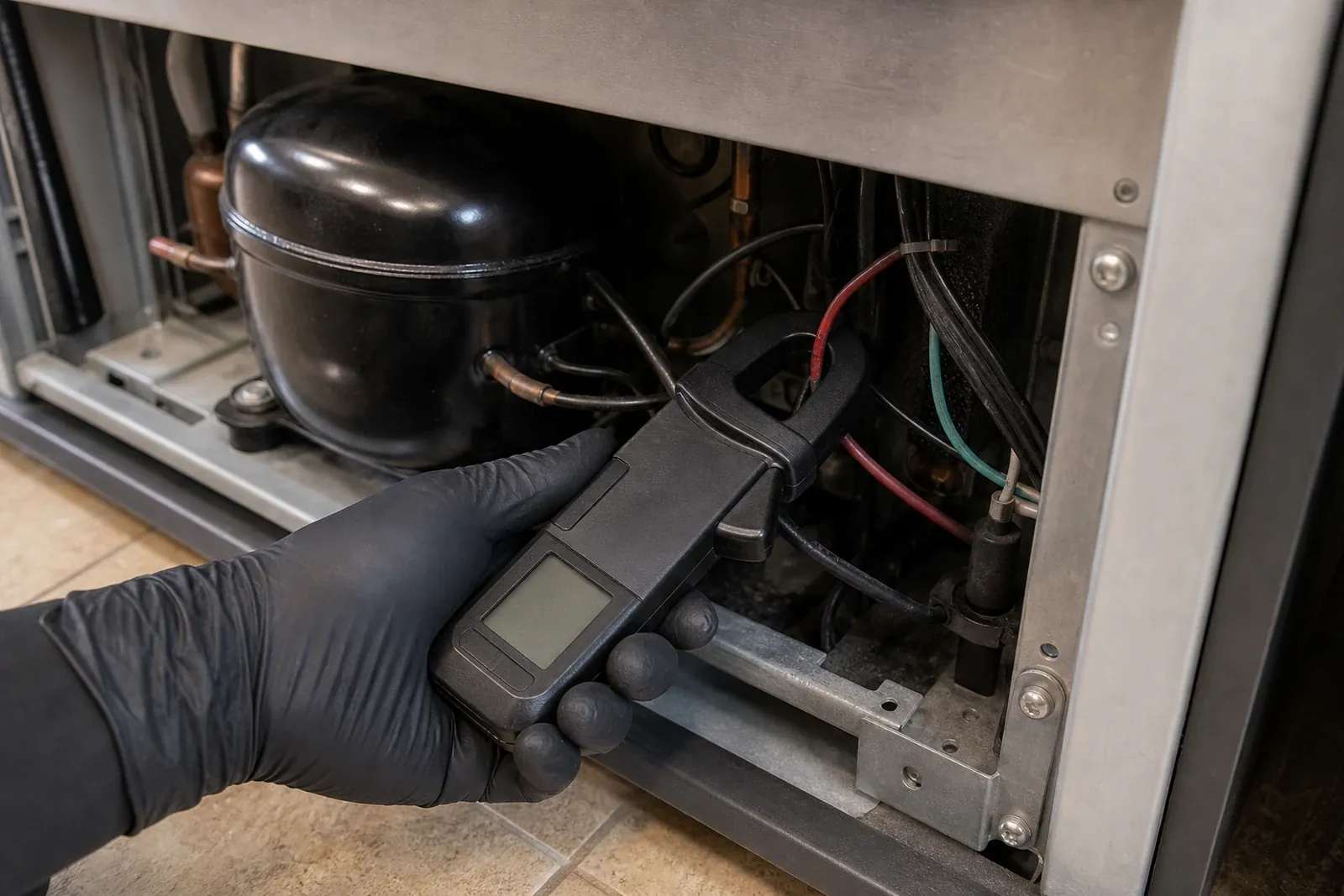
- A clamp meter on the compressor to read amp draw against the model's rated current. A compressor pulling locked-rotor amps, or far under spec, tells the story a hum never could.
- Touch and thermal checks across the drier, condenser, and evaporator inlet to locate a restriction's temperature split.
If we cannot reach the verdict without opening the sealed system, the diagnostic fee ($95–$150, credited toward an approved repair) buys you a written, instrument-based answer — not a guess. Anyone quoting a Sub-Zero compressor sight-unseen over the phone is guessing with your money. See our diagnostic fees and pricing for how that credit works.
Money
What sealed-system and compressor repair actually costs
Sealed-system work is the most expensive category of Sub-Zero repair because it requires EPA-certified refrigerant recovery, brazing, evacuation, and a fresh charge — hours of skilled work plus the part. Here is how it lands against the rest of the menu, with every flat quote approved before we touch a thing:
| Repair | Typical band | Notes |
|---|---|---|
| Condenser cleaning / minor non-sealed fix | $95–$300 | Often fixes long runs in hot, dusty San Ramon — try this first |
| Most non-sealed repairs (fan, board, thermistor, defrost) | $200–$650 | Single compartment usually affected |
| Sealed-system / compressor replacement | $900–$1,800 | Recovery, braze, evacuate, recharge; EPA 608 required |
| Diagnostic / service call | $95–$150 | Credited toward an approved repair |
Before you pay
The 12-year sealed-system warranty — check it first
Sub-Zero backs the sealed system — compressor, condenser, evaporator, drier, and tubing — with a 12-year manufacturer warranty on those parts. If your built-in is under twelve years old, the compressor part itself may be covered, which can turn a four-figure repair into mostly labor. Before you approve any sealed-system quote:
- Find your build date from the model and serial tag — Over/Under units carry it inside the fridge door near the top hinge; check our model number guide if you're not sure where to look.
- Ask us to confirm whether the failed component falls under the 12-year sealed-system coverage before any part is ordered.
Newer Dougherty Valley, Windemere, and Gale Ranch homes often run built-ins still inside that window — it's worth two minutes to check. We work the warranty question into the diagnostic, so you find out before you decide. For the bigger keep-or-toss math, see repair vs. replace.
Local conditions
How Tri-Valley heat and Diablo dust push a compressor over the edge
San Ramon is hard on sealed systems, and the geography matters. Inland Diablo Valley summers regularly run 90–100°F and spike toward 105°F during heat waves, so the condenser already fights a high ambient load — and an outdoor or kitchen-island unit baking on a Canyon Lakes or Norris Canyon patio runs hotter still. Layer on offshore Diablo winds and wildfire-season ash from the Diablo Range that blanket condenser coils within days, plus hillside dust in Dougherty Valley and Henry Ranch, and the compressor ends up running far longer and hotter than its designers intended.
That chronic overwork is how a tired compressor finally fails: it starts humming and buzzing under strain, runs constantly, and one hot week pushes it past recovery. The honest news is that catching it at the noisy-and-long-runs stage — and keeping the condenser clean every 3–6 months here, not the usual 6–12 — often saves the compressor entirely. Estate kitchens with steep driveways and gated access (Canyon Lakes, Norris Canyon) we note up front so the EPA-608 recovery visit runs on time. Stay ahead of it with our maintenance calendar and our Dougherty Valley dust-and-heat condenser guide.
Next step
Call with the Sub-Zero model number
Have the model-tag photo, current fresh-food and freezer temperatures, and the symptom timeline ready. That lets the San Ramon intake route the visit around the likely Sub-Zero part family instead of a generic appliance script.
FAQ
Questions San Ramon homeowners ask before scheduling
How much does a Sub-Zero compressor replacement cost?
Sealed-system and compressor work on a Sub-Zero typically runs $900–$1,800, because it involves EPA-certified refrigerant recovery, brazing, evacuation, and a fresh charge — not just swapping a part. By contrast, most non-sealed repairs are $200–$650. If your built-in is under twelve years old, the 12-year sealed-system warranty may cover the part itself, so we check that before quoting. Every price is a flat quote approved before work in San Ramon — (925) 940-3576.
Why is my Sub-Zero running constantly and never shutting off?
Constant running means the unit can't reach its setpoint. In San Ramon the most common and cheapest cause is a condenser coil smothered in Diablo-wind dust or wildfire-season ash, which we clean first. If both compartments are warm despite the nonstop running, it more often points to a low refrigerant charge, a restriction, or a weakening compressor — and that takes gauges and an amp-draw reading to confirm, never a phone guess.
What does it mean when a Sub-Zero is loud, humming, or buzzing?
A new, steady hum or buzz from the lower compartment usually comes from the compressor working under strain, and in Tri-Valley heat a noisy compressor often precedes failure. It can also be a condenser fan dragging on debris. Because the noise alone can't tell us which, we measure compressor amp draw against spec on-site. Catching it at the noisy stage — paired with a condenser cleaning — sometimes saves the compressor entirely.
Is it worth replacing the compressor in an old Sub-Zero?
Usually yes. A well-maintained Sub-Zero lasts 25–30 years, and a fresh compressor with a clean sealed system can add many more — far cheaper than a new built-in and the custom San Ramon cabinetry around it. We advise against it only when multiple major components have failed together or the repair exceeds roughly half a new installed unit's price. We'll give you that honest math after the diagnostic — see repair vs. replace.
Why won't you just quote the compressor over the phone?
Because the same symptoms — warm, loud, always running — can mean a $95 condenser cleaning or a $1,600 compressor, and only gauges plus an amp-draw reading tell them apart. Quoting a Sub-Zero compressor sight-unseen would be guessing with your money. Our $95–$150 diagnostic buys an instrument-based answer and is credited toward any approved repair across San Ramon and the Tri-Valley.
Do you need to be EPA-certified to do this repair?
Yes. Opening a Sub-Zero sealed system to recover and recharge refrigerant legally requires EPA Section 608 (Universal) certification — older San Ramon estates may run R-12, mid-era units R-134a, and current models R-600a isobutane, each handled to code. We're certified for all of it. See our EPA-608 refrigerant page for details.
Related