San Ramon · Sealed-system & refrigerant law
EPA 608 Certified Refrigerant Handling for Sub-Zero Sealed Systems in San Ramon
Opening a Sub-Zero sealed system is not a parts-swap — it is federally regulated refrigerant work. Under the Clean Air Act, anyone who recovers, recharges, or repairs the refrigerant circuit must hold EPA Section 608 (Universal) certification. Here is what that means for a San Ramon repair, and why the refrigerant inside your fridge changes the whole job.
Direct answer
Yes. Federal law (Clean Air Act, Section 608) requires EPA Universal certification to recover, recharge, or repair the sealed refrigerant circuit on any Sub-Zero. The technician must recover refrigerant — never vent it — pressure-test for leaks, and evacuate before recharging. Uncertified recharging is illegal. Call (925) 940-3576.
The law
Why EPA Section 608 Certification Is Not Optional
The sealed system is the closed refrigerant loop — compressor, condenser, evaporator, filter-drier, and the copper tubing that ties them together. The moment any of that is cut, brazed, recovered, or recharged, it falls under Section 608 of the Clean Air Act. The EPA requires a technician to hold a Universal certification (Type I covers small appliances; Universal covers everything) before touching the circuit.
That certification is not a formality. It governs how the job is legally done:
- Recovery, not venting. Refrigerant must be pulled into a recovery machine and recovery cylinder. Releasing it to the atmosphere is a federal violation.
- Leak verification. The system is pressure-tested and the repair confirmed leak-free before it is sealed and recharged — otherwise a recharge just leaks back out.
- Proper evacuation. The circuit is pulled into a deep vacuum to remove moisture and non-condensables before the exact charge weight goes back in.
So when a San Ramon homeowner asks whether "anyone" can recharge a Sub-Zero, the honest answer is no — not legally, and not well. There is also a practical reason the rule exists: a refrigerant charge is measured to the gram, and a system that simply gets "topped off" without finding and fixing the leak will be warm again in weeks. Recovery and proper evacuation also protect the new compressor from moisture that would otherwise destroy it. A non-cooling fridge that turns out to need sealed-system work is exactly the diagnostic we walk through on our sealed-system & compressor page.
Know your fridge
Three Refrigerant Eras Live in San Ramon Kitchens
San Ramon's housing stock spans six decades — from the 1960s–70s ranch homes in San Ramon Village to the panel-ready built-ins going into Gale Ranch, Windemere, and Dougherty Valley today. That range means three different refrigerants are still in service across town, and each one changes how the repair is handled — the recovery procedure, whether the charge can be reused, and the precautions taken while brazing. We confirm which refrigerant you have from the model and serial tag (see our model-number guide) before any sealed work begins, because guessing the wrong gas is both unsafe and illegal.
| Refrigerant | Typical San Ramon home | What it means for the repair |
|---|---|---|
| R-12 (CFC) | Older estates & legacy built-ins (pre-1995) | Phased out; recovered & reused or retrofitted — virgin R-12 no longer produced |
| R-134a (HFC) | Mid-era units, much of the 500/600/early BI series | Still serviceable; recovered, evacuated, recharged by weight |
| R-600a (isobutane) | Current Designer, Classic & PRO built-ins | Flammable hydrocarbon; tiny charge, special handling & brazing precautions |
R-12 reality
Is an R-12 Sub-Zero Still Worth Servicing?
Plenty of Norris Canyon Estates, Diablo, and original San Ramon Village kitchens still run a Sub-Zero charged with R-12. It was phased out of production under the Montreal Protocol, so no new R-12 is manufactured — but the system is still serviceable. A 608-certified technician recovers the existing R-12 into a dedicated cylinder, makes the repair, evacuates, and returns the recovered charge or a reclaimed equivalent. We do not vent it and we do not mix refrigerants.
Because a maintained Sub-Zero runs 25–30 years, an R-12 unit with sound cabinetry is often worth keeping — the same repair-or-replace math we lay out on our repair vs. replace page. What it is not is a job for an uncertified handyman with a can of mystery gas.
R-600a caution
Current Built-Ins Use Flammable R-600a — Handled Accordingly
Sub-Zeros built in recent years use R-600a (isobutane), a hydrocarbon refrigerant prized for efficiency and zero ozone impact. The catch: it is flammable. The charge is small, but brazing near a live circuit, ignition sources, and ventilation all matter. This is one more reason the sealed system is no place for guesswork — proper recovery, a clean work area, and correct charge-by-weight aren't optional with isobutane.
It also reinforces why a flat quote is approved before work on our visits. Once the system is diagnosed we tell you whether it's a non-sealed fix (most repairs land $200–$650) or true sealed-system/compressor work ($900–$1,800), and whether the factory warranty below covers it — before anyone picks up a torch.
Warranty first
Check the 12-Year Factory Sealed-System Warranty First
Before you pay a dollar for sealed-system work, there is good news worth confirming: Sub-Zero carries a 12-year manufacturer warranty on the sealed system — compressor, condenser, evaporator, filter-drier, and connecting tubing. Many San Ramon homeowners don't realize their built-in qualifies. We help you read the model and serial off the tag and check coverage before quoting parts.
If a sealed component is in-warranty, the part may be covered and you pay labor only — a meaningful difference on a $900–$1,800 job. If it's out of warranty, you get an honest flat quote. Either way the diagnostic fee ($95–$150) is credited toward the repair, and the whole picture is laid out on our San Ramon repair-cost page. You can book online or call (925) 940-3576.
What we do
What Sealed-System Service Actually Involves in the Field
A sealed-system visit to a Bishop Ranch condo or a Canyon Lakes estate follows the same disciplined sequence — diagnosis first, refrigerant work only when the evidence supports it:
- Confirm the symptom. Both compartments warm, a compressor running constantly, or loud humming points toward the sealed system — but a dirty condenser from Diablo wind-driven dust mimics the same thing, so we rule that out first.
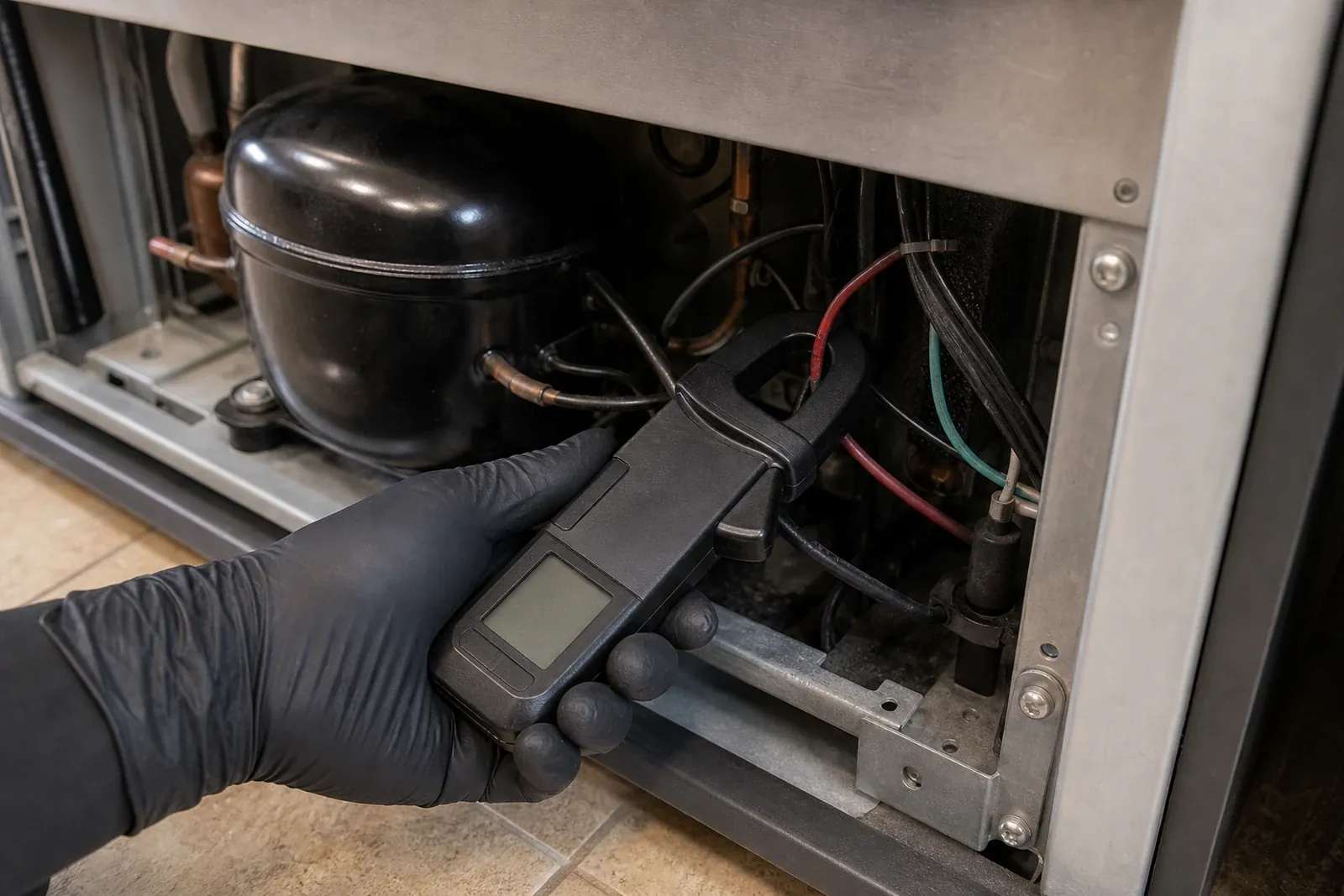
- Verify with gauges and amp draw. Sealed-system faults are never phone-quoted; they need pressure readings and a compressor amperage check.
- Recover the refrigerant into a recovery machine — R-12, R-134a, or R-600a, each handled by its own procedure and cylinder.
- Repair, evacuate, recharge by weight, then leak-verify before the panels go back.
The mid-era R-134a units that fill many Twin Creeks and Canyon Lakes kitchens are the most straightforward of the three — still in production, recovered and recharged conventionally — but they get the same gauge-and-amp diagnosis, because a low charge and a failing compressor look identical from the front of the box. If your fridge is warming and you're not sure it's the sealed system yet, start with the not-cooling diagnostic — most "sealed-system" scares in San Ramon turn out to be a condenser caked with Diablo dust and a quick coil cleaning.
Next step
Call with the Sub-Zero model number
Have the model-tag photo, current fresh-food and freezer temperatures, and the symptom timeline ready. That lets the San Ramon intake route the visit around the likely Sub-Zero part family instead of a generic appliance script.
FAQ
Questions San Ramon homeowners ask before scheduling
Is EPA 608 certification required to work on Sub-Zero refrigerant?
Yes. Under Section 608 of the Clean Air Act, anyone who recovers, recharges, or repairs a sealed refrigerant circuit must hold EPA certification — Universal certification covers all Sub-Zero appliances. The technician must recover refrigerant into a recovery machine rather than vent it, leak-test the repair, and evacuate before recharging. It is a federal requirement, not a preference.
What refrigerant does my Sub-Zero use?
It depends on the era. Older San Ramon estate units (pre-1995) typically use R-12; mid-era and many 500/600/early built-in models use R-134a; current Designer, Classic, and PRO built-ins use R-600a isobutane. We read it off the model and serial tag before any sealed work — never guess, since the refrigerant dictates the recovery and brazing procedure.
Can anyone recharge a Sub-Zero?
No — not legally and not reliably. Recharging the sealed circuit requires an EPA Section 608 certified technician, proper recovery and evacuation equipment, and a leak-verified repair so the new charge doesn't simply leak back out. A handyman "topping off" gas without finding the leak wastes refrigerant and your money. Sealed work is gauge-and-amp diagnosed, then quoted flat: (925) 940-3576.
Is R-12 still serviceable in an older Sub-Zero?
Yes. R-12 is no longer manufactured, but a certified technician recovers the existing charge, makes the repair, evacuates, and returns recovered or reclaimed R-12 — it is never vented or mixed. Many older Norris Canyon, Diablo, and San Ramon Village built-ins still run R-12, and with sound cabinetry they're usually worth keeping given a Sub-Zero's 25–30 year lifespan.
Is my Sub-Zero's sealed system under warranty?
Possibly. Sub-Zero carries a 12-year manufacturer warranty on the sealed system — compressor, condenser, evaporator, filter-drier, and tubing. We help you read the serial off the tag and check coverage before quoting, since an in-warranty part can mean you pay labor only on an $900–$1,800 job. Always confirm before paying for sealed-system parts.
How do you know it's the sealed system and not just dirty coils?
We rule out the cheap causes first. San Ramon's Diablo wind-driven dust and wildfire-season ash cake condenser coils within months, which mimics sealed-system symptoms — a long-running compressor and a warm box. We clean and re-test, then confirm a true sealed fault only with pressure gauges and a compressor amp-draw reading. No sealed-system repair is quoted over the phone.
Related